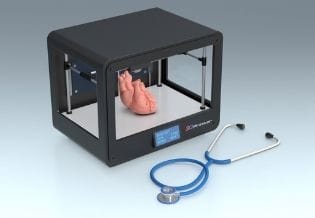
About 3D Printing and Applications
Advancing additive manufacturing science through rigorous peer review - connecting materials engineers, process scientists, fabrication specialists, and industrial researchers worldwide.
J3DPA provides a dedicated publishing venue for additive manufacturing research that spans fundamental material science to industrial-scale process development. Our peer review process combines domain expertise in mechanical engineering, materials characterization, computational modeling, and manufacturing systems to ensure technical accuracy and methodological soundness.
Authors benefit from a streamlined submission workflow, constructive peer review feedback, and immediate online publication upon acceptance. Our open access model ensures maximum visibility for your research across academic institutions, industrial research labs, and technology development centers worldwide.
J3DPA welcomes original research manuscripts, review articles, technical notes, and case studies across the following manufacturing-focused domains:
Fused deposition modeling (FDM), stereolithography (SLA), selective laser sintering (SLS), binder jetting, material jetting, directed energy deposition, and emerging fabrication technologies.
Polymer processing, metal alloy development, ceramic materials, composite systems, bio-based materials, and functional material characterization for additive manufacturing.
Parameter optimization, print quality analysis, layer adhesion studies, temperature control, post-processing techniques, and manufacturing workflow efficiency.
Tensile strength testing, fatigue analysis, surface roughness measurement, dimensional accuracy assessment, and structural integrity evaluation of printed components.
Finite element analysis, thermal modeling, process simulation, topology optimization, and predictive algorithms for print quality and structural performance.
Inspection methodologies, defect detection, measurement techniques, standardization frameworks, and certification protocols for additive manufacturing systems.
Manufacturing tooling, prototyping systems, production-scale fabrication, spare part manufacturing, and industrial automation integration.
Material waste reduction, energy efficiency analysis, lifecycle assessment, cost-benefit evaluation, and environmental impact studies of additive manufacturing processes.
J3DPA's editorial operations are guided by an international board of manufacturing engineers, materials scientists, and additive manufacturing specialists who bring deep technical expertise across diverse fabrication technologies and material systems.
J3DPA employs a rigorous single-blind peer review process to evaluate all submissions. Manuscripts are assessed for technical soundness, methodological clarity, reproducibility, and significance to the additive manufacturing research community.
Editorial office verifies scope alignment, formatting compliance, and ethical documentation within 72 hours of submission.
Manuscripts undergo evaluation by 2-3 specialists in relevant additive manufacturing domains, focusing on technical merit, experimental design, and data interpretation.
Editors synthesize reviewer feedback and communicate accept, minor revision, major revision, or reject decisions with detailed guidance.
Authors address reviewer comments through point-by-point responses and manuscript updates for expedited re-evaluation.
Accepted manuscripts undergo copyediting and are published online with immediate open access availability and DOI assignment.
J3DPA welcomes original research articles, review papers, technical notes, and case studies that advance understanding of 3D printing processes, materials, and manufacturing methods. All submissions must represent original work not previously published or under consideration elsewhere.
- Manuscript Format: Submit as editable Microsoft Word document with structured sections including abstract (250 words), introduction, methods, results, discussion, and conclusions.
- Keywords: Provide 5 relevant keywords reflecting the manuscript's technical focus and methodology.
- Figures & Tables: Include high-resolution figures (minimum 300 DPI) and clearly labeled tables with descriptive captions.
- Supplementary Materials: Authors may submit supporting data, videos, CAD files, or extended methodological details to enhance manuscript comprehension.
- Ethics Documentation: Include institutional approval documentation if research involves human subjects or regulated materials.
J3DPA operates under a fully open access publishing model, making all content freely available to readers worldwide immediately upon publication. Articles are published under Creative Commons Attribution (CC BY 4.0) licensing, permitting unrestricted use, distribution, and reproduction with proper attribution.
To sustain rigorous peer review, professional copyediting, and global indexing services, J3DPA applies a nominal Article Processing Charge (APC) upon manuscript acceptance. Authors affiliated with institutions holding institutional memberships may qualify for APC discounts or waivers.
- Open Access Visibility: Articles receive immediate worldwide distribution through academic search engines, institutional repositories, and scholarly databases.
- Rapid Publication: Streamlined editorial workflow ensures minimal time from submission to online publication for accepted manuscripts.
- Global Indexing: J3DPA is indexed in multiple academic databases, enhancing discoverability and citation potential for published research.
- Author Retention: Authors retain copyright under CC BY 4.0 licensing, enabling unrestricted sharing and reuse of published work.
- Rigorous Standards: Peer review by additive manufacturing specialists ensures technical accuracy and methodological soundness.
- Ethical Compliance: Editorial policies align with international standards for publication ethics, data transparency, and research integrity.
Editor in chief