
The Dose Modulates the Body’s Physiology: Literature Review
- Open Access
- Peer Reviewed
- Similarity Checked
- CC BY 4.0

Abstract
The body interacts with endogenous and exogenous molecules through various receptor networks at the cellular and organismal levels by which the different physiological processes of the organ systems get activated. Life could no longer exist without the body’s interaction with these signaling molecules. The number of molecules interacting with a receptor type within the body determines the efficiency of biological processes that would determine the biochemistry and anatomy behind the basic body functions.
The dose plays a complex role in multiple physiological processes by modulating the natural processes of the different biological systems. It is always connected to the physiological and anatomical aspects of the biological sciences in which it manifests the biological sensitivity that would determine the efficiency of biological responses of the body systems. There are always physiologic and non-physiologic doses for every compound administered into the biological systems. The dose that facilitated the body to manifest that biological sensitivity which has maintained the physiological processes of the body systems was noted as physiologic dose, whereas the dose that has suppressed the biological sensitivity of the body that became inefficient in maintaining the physiological processes of the different biological systems was termed non-physiologic dose.
It is important to adjust the dose or dosage based on physical and biological factors such as the efficiency of the different organ systems, body weight, and the timing of the dose triggering a biological response to maintain the natural processes of the body systems. This means that integrated biological data is required in order to be able to identify the physiologic and non physiologic doses for biological or pharmacological use.
Article Information
- Received
- Accepted
- Published
Academic Editor: Zubair Anwar, Baqai Institute of Pharmaceutical Sciences
Checked for plagiarism: Yes
Review by: Single-blind
Copyright © 2025 Yilkal Tariku Belay.
 This is an open-access article distributed under the terms of the Creative Commons Attribution License, which permits unrestricted use, distribution, and reproduction in any medium, provided the original author and source are credited.
Corresponding author: Yilkal Tariku Belay, School of Biomedical Sciences, College of Health Sciences, Makerere University, Kampala, Uganda —
Competing Interests
The authors declare that they have no competing interests.
Funding
No specific funding statement was provided by the authors.
Data Availability
No data-availability statement was provided by the authors.
Citation:
Introduction
The concept of dose is fundamental in pharmacology and toxicology by which the toxicity of a test compound is believed to be avoided. However, its significance in life sciences often goes unrecognized. The relationship between dose and biological response remains a contentious topic in experimental pharmacology and toxicology. Undertaking comprehensive research in this area is crucial to gaining fresh insights and perspectives with far-reaching implications for drug safety regulations. This report offers an overview of the impact of different levels of doses on the body’s physiological and biological processes,
The body’s interaction with both internal and external molecules through various receptor networks at cellular and organismal levels is essential for sustaining life. These interactions activate physiological processes in biological systems and are facilitated by intracellular receptors, G-protein coupled receptors, ligand-gated ion channels, chemoreceptors, thermo-receptors, photoreceptors, sound-receptors, among others1. When these interactions are disrupted, the body’s functionality is compromised, underscoring the critical nature of its connection with the external environment for survival. The efficiency of biological processes and the foundational biochemistry and anatomy of basic body functions are determined by the number of signaling molecules interacting with specific receptor types within the body2. Maintaining a balanced interaction between different signaling molecules and their receptor types is crucial for ensuring the continuity of biological processes throughout the body’s lifespan3. The body is composed of cells which are in turn made up of water, inorganic ions, and organic molecules4. It needs daily doses of substances to maintain the equilibrium required for physiological processes in different biological systems4.
The dosage has a complex role in many physiological processes by influencing the natural processes of the different biological systems2. It is closely related to the physiological and anatomical aspects of the biological sciences, where it demonstrates the biological sensitivity that determines the effectiveness of biological processes in different organ systems. The body’s biological processes include all chemical processes that prepare substances to be used for energy, fertility, and growth as well as physiological and defense mechanisms3. Every compound administered into biological systems has both physiologic and non-physiologic doses. The physiologic dose facilitates the body’s biological sensitivity, maintaining biological processes, while the non-physiologic dose desensitizes the body, hindering physiological processes. Lower and moderate doses are mainly physiologic, activating biological sensitivity and maintaining physiologic activities, while higher doses are mainly non-physiologic, desensitizing cellular and molecular responses and suppressing natural body processes5.
This limited response efficiency against signaling molecules impacts the biological processes of different organ systems. For instance, in previous studies, the lower doses of Chlorpyrifos and Cypermethrin pesticides boosted the immunoglobulin’s immune responses of treated Balb c mice while the higher doses suppressed it5. The doses that are considered to be within the normal range (physiologic dose) can still be harmful to the body in the long term, leading to inaccurate toxicology reports for test compounds5, 6. This means that it is not the dose itself which is toxic or nontoxic but rather the substance6. When different levels of doses are given to biological systems, they create a curve that helps us distinguish between physiological and non-physiological doses7. Physiological doses are shown with an upward curve in response, while non-physiological doses are represented with a downward curve (Figure 1).
Figure 1. The dose-biological response relationships of test compounds administered to Balb c mice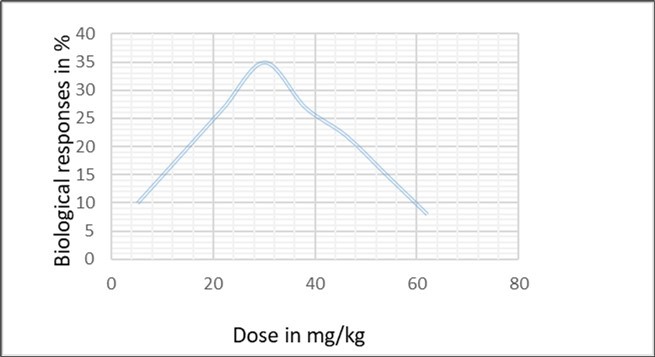
Download figure
“The various levels of doses led to different biological processes,”
It is well known that our bodies undergo various physiological changes at different stages of development due to imbalances in the levels of natural molecules. The balance between estrogen and progesterone hormones, for instance, plays a crucial role in shaping the physiology and anatomy of the female reproductive system8, 9. In females, estrogen hormone affects the reproductive tract, the urinary tract, bones, breasts, skin, hair, mucous membrane, pelvic muscles, and the brain. Secondary sexual characteristics, such as pubic and armpit hair, have begun to grow in response to high levels of estrogen hormone in the body 8, 9. Elevated levels of estrogen hormone are also necessary for the development of mammary glands and ovarian follicles, which are small sacs within the ovaries that contain immature eggs9. The ovaries are always influenced by changes in estrogen levels, leading to cyclical ovulation9.
During pregnancy, a woman undergoes various physiological and anatomical changes in different organ systems such as endocrine and mammary glands, cardiovascular, respiratory and urinary systems. These changes occur in response to high levels of progesterone and reduced estrogen levels in the body 10. Most of these physiological changes manifested during pregnancy will return to normal in the postpartum period. Adolescent women experience quite different physiological processes during pregnancy, lactation and non pregnancy periods due to fluctuations in hormone levels. Generally, both human and animal endocrine glands release different levels of hormones during their reproductive cycle to regulate the physiology and anatomy of the body systems.
Let us also discuss the physiological aspect of our daily diets. When we eat our regular meals, we usually experience a sense of comfort due to our natural biological sensitivity to hunger. As we eat, we gradually feel better until we reach a point of physiological satisfaction, which comes from consuming an appropriate amount of food. However, if we continue eating beyond this point, our body may begin to exhibit physiological issues such as depressed biological sensitivity (loss of taste), weakness, sluggishness, discomfort as well as nausea and vomiting. This is caused by overeating, where we consume more than the body needs.
When considering the physiology of alcoholism, it is important to note that moderate alcohol consumption causes blood vessels to relax, allowing more blood to flow through the skin and tissues11. This leads to a drop in blood pressure and an increase in heart rate11. On the other hand, at high levels of alcohol consumption, the body undergoes a different physiological state. Alcohol affects various neurotransmitters in the brain, including opiate, GABA, glutamate, Serotonin and dopamine11. The increased opiate level can help explain the euphoric effect of alcohol while its effect on GABA causes anxiolytic and sedative effects11. Furthermore, alcohol inhibits the receptor for glutamate in which long term consumption results in the synthesis of more glutamate receptors11.
Let us also consider the physiology of Adenosine molecules, as an example. Adenosine plays a complex role in various physiological and pathophysiological processes. It modulates neuronal plasticity, astrocytic activity, memory, motor function, control of sleep, feeding and ageing12. Adenosine also plays a key role in the adaptive response in pulmonary hypertension and heart failure by slowing down heart rhythm, coronary vasodilation, and decreasing blood pressure12.
It is important to adjust the dose or dosage based on physical and physiological factors such as the efficiency of organ systems, body weight, and the timing of the dose triggering a biological response to maintain the natural processes of the body systems. Integrated biological data is required to identify the physiologic and non physiologic doses for biological or pharmacological use. Identifying the physiologic dose of a test compound is crucial in drug discovery and development for a safe therapeutic agent. On the other hand, identifying non physiologic doses is necessary in supporting the regulatory categorization and harmful labeling decisions in toxicological studies.
Conclusion
The primary purpose of a dose is to regulate the physiology of the body by influencing the biochemistry and anatomy behind the basic body functions to support life processes. Its goal is to ensure that life can continue based on the body’s needs. There is a physiologic dose and a non physiologic dose for a compound administered to a biological system. The physiologic dose may eventually exhibit toxicity in the long run throughout an organism’s life process, which can result in inaccurate toxicological study reports. This implies that there is no specific toxic dose or non-toxic dose but rather toxic or non-toxic substances.
References
- 1.Bertram G Katzung, Susan B Masters, Anthony J Trevor. (2012) . Drug receptors and Pharmacodynamic, Basic and Clinical pharmacology; McGraw Hill CampaniesInc, 12thedition 1-37.
- 2.Physiology. (2024) Maternal Changes. [Updated 2023]. In: StatPearls [Internet]. Treasure Island (FL): StatPearls Publishing;.
- 4.Yilkal Tariku Belay. (2019) Misconception about the role of a dose in pharmacology: Short review report on the biological and clinical effects. Adv Bioeng Biomed Sci Res (opastpublishers) 2(3).
- 5.Belay Y T. (2019) Study of the principles in the first phase of experimental pharmacology: the basic step with assumption hypothesis. BMC Pharmacol 20(1), 10-1186.
- 6.Belay Y. (2011) Study of safety and effectiveness of traditional dosage forms of the seed of Aristolochiaelegansmast against malaria and laboratory investigation of pharmaco-toxicological properties and chemical constituents of its crude extracts, Ann Trop Med Public Health;. 4, 33-41.
- 7.Belay Y. (2019) The Dose and its Acute Toxicology: A Systematic Review Article in the First Phase of Experimental Pharmacology. J Comp Biol Sys 2(1), 104.
- 8.Lee H R, Kim T H, Choi K C. (2012) Functions and physiological roles of two types of estrogen receptors, ERα and ERβ, identified by estrogen receptor knockout mouse. 10.5625/lar.2012.28.2.71. Epub , Lab Anim Res 28(2), 71-6.
- 9.An B S, Choi K C, Hong E J, Jung Y W, Manabe N et al. Differential transcriptional and translational regulations of calbindin-D9k by steroid hormones and their receptors in the uterus of immature mice. J Reprod Dev 50(4), 445-53.
- 10.Soma-Pillay P, Nelson-Piercy C, Tolppanen H, Mebazaa A. Physiological changes in pregnancy. Cardiovasc J Afr 27(2), 89-94.