
A Solar Water Heater Using a Two-Stage Thermostat as a Pre-Heating System for a Feed Plant

Abstract
Solar thermal heating is a mature technology for producing hot water in the domestic sector. Industrial processes require significant heat, so solar water heaters can be used for pre-heating. A forced-circulation solar water heater is installed in a feed plant that is located south of the Tropic of Cancer. The thermal efficiency of the system is closely related to the incident solar radiation. This study uses a two-stage setting for a thermostat to collect more solar energy if incident solar radiation is less intense. When the temperature difference between the water storage tank and the water outlet for the solar collectors (setting of a thermostat from 6° to 8°C) increases, there are more energy savings. The simple payback period for the system is 2.05 years, so it is financially viable to use a solar water heater for industrial heat processes. Excessive carbon emissions resulting from industry processes are a main cause of global warming. Carbon tax can be used as a central climate policy instrument for carbon reduction. The government of Taiwan stipulates the legal foundation for levying carbon fees in 2025. The carbon emissions and carbon tax for the feed plant are described to prompt the case for sustainability.
Article Information
- Received
- Accepted
- Published
Academic Editor: Loai Aljerf, Department of Life Sciences, Faculty of Dentistry, University of Damascus
Checked for plagiarism: Yes
Review by: Single-blind
Copyright © 2026 Keh-Chin Chang, et al.
 This is an open-access article distributed under the terms of the Creative Commons Attribution License, which permits unrestricted use, distribution, and reproduction in any medium, provided the original author and source are credited.
Corresponding author: Kung-Ming Chung, National Cheng Kung University, East, Tainan, Taiwan, 701 —
Competing Interests
The authors have no conflict of interest to declare.
Funding
This research was funded by the Energy Bureau, Ministry of Economic Affairs, Taiwan, Republic of China, under grant number 108-D0709.
Data Availability
No data-availability statement was provided by the authors.
Citation:
Introduction
Excessive carbon emissions from corporate production are one of the main reasons for global warming 1, 2, 3. Carbon reduction in the industrial sector is crucial for achieving United Nations Sustainable Development Goals (SDG 12: responsible consumption and production; SDG 13: climate action) 4, 5, 6. In terms of the climate policy framework for carbon neutrality, environmental legislation (carbon emission standard, carbon taxes, carbon cap and the cap-and-trade carbon regulation) is a critical policy instrument for the transformation of society towards low-carbon and sustainable development. A study by Li and Wang 7 showed that there is a robust inverse relationship between carbon tax and carbon emissions, so renewable energy investment is also encouraged. Operating fees for industries and corporate value are the other concerns.
Renewable energy sources (wind power, photovoltaic power, geothermal power, solar thermal power and solar thermal heat) are sustainable 8, 9, 10. In 2024, the global renewable energy yield was more than 5763 TWh. Wind turbines and photovoltaic systems (PV) respectively supplied 2777 TWh and 2437 TWh of electricity. In terms of solar thermal heating, the global capacity is 544 GWth and there are more than 110 million systems in operation for the production of hot water. Solar thermal systems supplied 443 TWh of heat, which corresponds to a saving of 47.6 million tons of oil and a reduction of 153.7 million tons of CO211. This is a significant reduction in global greenhouse gas emissions.
Solar thermal heating is a mature technology 12, 13, 14 and is an indispensable element of the transition to a low-carbon economy. Solar water heaters (SWHs) that produce hot water with a temperature of less than 100 °C are the most relevant applications. In the domestic sector, the area of solar collectors Asc for an SWH is typically less than 10 m2.These systems use natural circulation (thermosyphon effect), whereby warm water rises and cold water flows downward 15. For industrial applications, Islam et al. 16 showed that large-scale SWHs are more economically feasible and can be used as a pre-heating system for a boiler. Industrial heat processes (food, wine and beverage, textile, pulp and paper industries), which account for 51% of the energy that is consumed for heat, require significant amounts of heat at less than 400°C. In this context, there is a burgeoning market for SWHs 17, 18, 19.
System performance and energy savings for SWHs are the dominant factors in determining whether solar thermal heating is a feasible option for industrial heat processes. The thermal efficiency of an SWH depends on the incident solar irradiance I, the thermal performance of solar collectors ηsc and the hot water consumption pattern. For a large-scale SWH using forced circulation, a reverse-type thermostat that is set at a specific temperature is fixed at the outlet of the solar collector. The circulation pump switches on and off when the outlet temperature equals or exceeds the temperature at which the thermostat is set.
Some field measurements have been conducted to determine the thermal efficiency η for large-scale SWHs. For a girls’ dormitory system (Asc = 84.7 m2), Lin et al. 20 showed that the solar fraction is less than 50% of total water heating energy in the winter season and particularly at lower ambient temperatures. The value of η (< 0.45) is even less than the value for a residential SWH. In a livestock processing plant, SWHs were used for scalding and de-hairing (two systems: Asc = 12.5 m2 and 115.8 m2). The value of η (< 0.64) increases as the global solar radiation increases. The hot water consumption pattern and the mass flow rate affect the system’s thermal efficiency. In a poultry slaughterhouse, inlet water temperature, incident global solar radiation and load pattern are the dominant factors determining the system’s thermal efficiency (three systems: Asc = 70.2 m2, 117.0 m2 and 187.2 m2; η = 0.36-0.57). The water circulation rate is another concern 21.
Field measurements of large-scale SWHs for industrial heat processes are still very limited. The effect of the settings for a thermostat on the thermal efficiency of an SWH has yet to be determined. This study determines the thermal performance for an SWH in a feed plant. The effect of two-stage settings for a thermostat is determined and the field measurement data is analyzed. The results are used to inform decisions on the use of solar thermal heating for industrial heat processes.
In response to global climate change, environmental, social, and governance principles form a critical framework for evaluating the sustainability and ethical practices of companies 22. Carbon tax is a central climate policy instrument to decrease carbon emissions. This study determines the reduction in carbon emissions if a SWH for a feed plant.
Material and Methods
Solar collectors
The thermal performance of solar collectors has a significant effect on the thermal efficiency of a SWH. This study uses glazed, metallic flat-plate solar collectors (DYY-B1, DYY Solar Industrial Co. Ltd.). The value of Asc for each solar collector is approximately 1.97 m2. The 10-12 risers are made of copper and the thickness of the tempered glass is 3 mm.
In Taiwan, a national standard (the Chinese National Standards, CNS 15165-1-K8031-1) is in compliance with ISO 9806:1994. It specifies an outdoor test method to determine the steady-state thermal performance of solar collectors (natural solar irradiance ≥ 800 W/m2). Chung et al. 23 also showed that the effect of diffuse solar radiation on the thermal performance of a glazed, metallic, flat-plate solar collectors is not significant. The test facility for the thermal efficiency of a solar collector with water load at the Energy Research Center, National Cheng Kung University (ERC/NCKU) is shown in Figure 1.
The solar collectors for this study faced south at a tilt angle of 23° to optimize the collection of solar radiation. A precision spectral pyranometer (Eppley, Model PSP; uncertainty = ±0.91%) was used to determine the value of I. The water mass flow rate ṁ is 0.02 kg/s/m2 and is determined using a flow meter (Macnaught, Model G2SSP-1R; uncertainty = ±0.1%) that is positioned along the water supply line. Three platinum resistance thermometers (Thermoway, Model PT100; uncertainty = ±0.1°C) were installed to record the ambient temperature, Ta, the initial temperature in the cold-water supply line Tin and the final outlet temperature in the solar collectors Tout. The wind speed was measured using an anemometer (Young Co., Model 05103L; uncertainty = ±0.03 m/s). Each test sequence used four input temperatures (Ta±3°C, 45°C, 60°C and 70°C). Data from the monitoring devices was sampled every second using a data acquisition system (M-7015p and M-7017z, Pactech, Inc.). The value of ηsc is calculated using Equation 1, and the calibration curve is shown in Figure 2. The intercept FR(ta) is the useful energy that is obtained from a solar collector, and the gradient FRUL represents heat loss. The respective values are 0.776 and 4.66.
 (1)
(1)
Figure 1. Calibration setup for the solar collector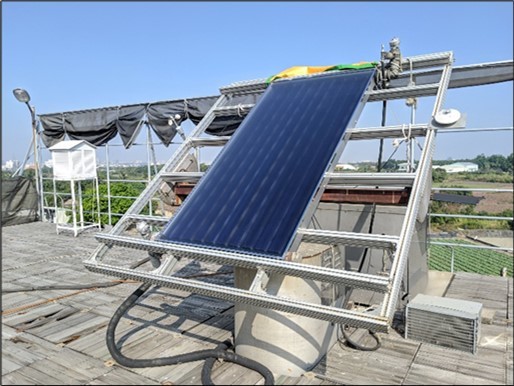
Download figure
Figure 2. Efficiency curve for the solar collector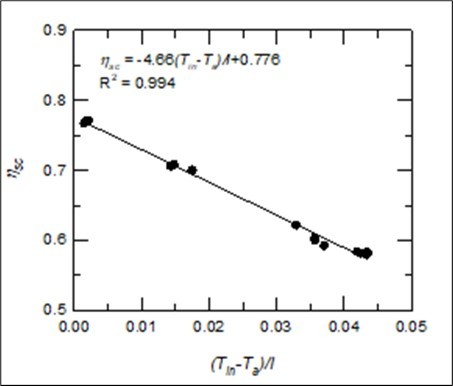
Download figure
An SWH for a feed plant
The feed plant is located in Pingtung County, Taiwan (22°22’11’’N, 120°35'10’’E, which is south of the Tropic of Cancer). It produces 0.2 million tons of soybeans, corn, and wheat per annum. Four boilers supply steam at 6 bar and 158°C. The daily water consumption is 30-40 tons. Heat is required for three stages: ambient temperature to 100°C (liquid, specific heat capacity = 4.2 kJ/(kg·K)), gasification (latent heat, 2257 kJ/kg), and steam superheating (100°C to 158°C, 498 kJ/kg). The plant consumes approximately 70,000 liters of low-sulfur light fuel oil per month. The price of low sulfur-light fuel oil varied between 400 and 854 US$/kL from 2020 to 2025 24.
An SWH with flat-plate solar collectors can supply hot water of 70°C. The monthly global solar radiation, Gm, as determined using the Kriging method 25, as shown in Figure 3. The value ranges from 310 MJ/m2 (January-February) to 532 MJ/m2 (July). This shows that the location of the feed plant is ideal for the use of solar thermal heating. A south-facing SWH was installed on a roof with a 6° pitch on a low-rise building to minimize shading, as shown in Figure 4. The area of the 60 glazed flat-plate solar collectors is approximately 118 m2. Garg 26 showed that a parallel arrangement produces maximum thermal efficiency. This study uses three solar collectors in series (an array) with one inlet and one outlet to heat cold water. The arrays are then connected in parallel, as shown in Figure 5.
A hot water tank stores 2 tons of water. A reverse-type thermostat is used to control a circulation pump, which is switched on and off depending on the temperature difference (6°C/2°C for the baseline case) between the water storage tank and the water outlet for the solar collectors. The flow rate is 200 liters/minute. The temperature difference at which the thermostat is set has a significant effect on the system performance of an SWH. This study uses a programmable logic controller (PLC) to control the settings for the thermostat. The circulation pump is switched on and off (6°C/2°C; 8°C/2°C) if the value of I is greater than 400 W/m2. For a low value of I (< 400 W/m2), a setting of 3°C/1°C aims to produce better performance for the SWH than the baseline case.
Figure 3. Monthly solar radiation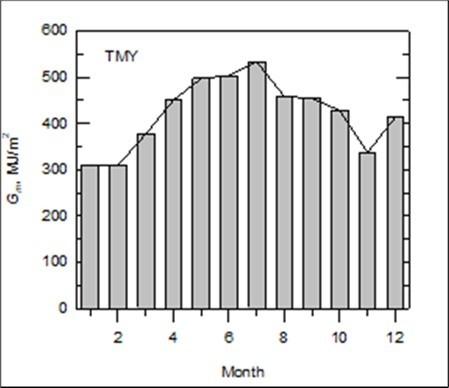
Download figure
Figure 4. The setup for the SWH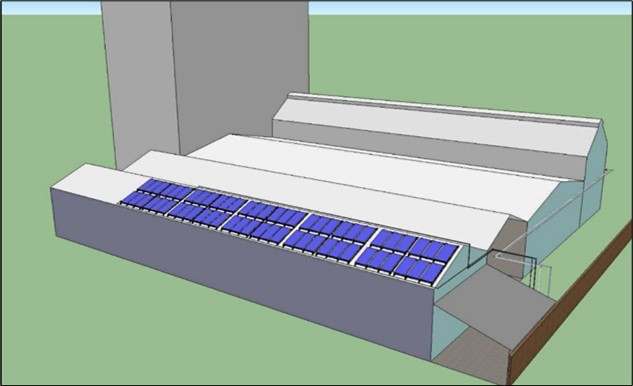
Download figure
Figure 5. Configuration of the SWH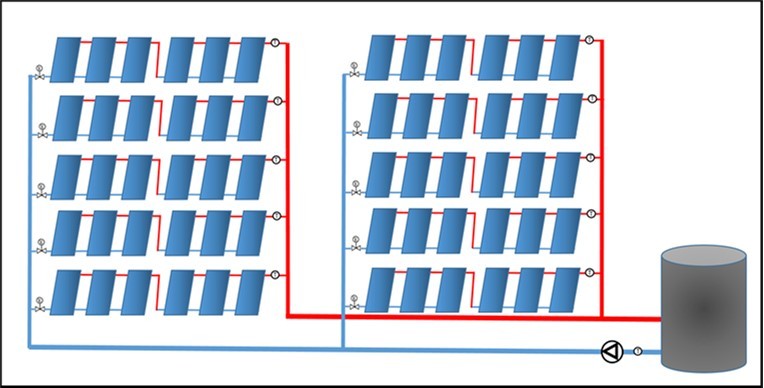
Download figure
Field measurements
Several monitoring devices recorded the operating conditions for the SWH. A precision spectral pyranometer (Kipp & Zonen Inc., model CMP11) was used to determine the value of I. A Macnaught flow meter (Model M2SSP-1R) was located in the cold-water supply line to the water storage tank to record hot water consumption, ṁ, and another flow meter was installed in the circulation line from the bottom of the water storage tank to the inlet of the solar collectors (mass flow = 200 LPM). Nineteen platinum resistance thermometers (Izuder Enterprise, 1/10 DIN Class B) measured the local water temperature and ambient temperature.
The data from the monitoring devices was sampled using ICP DAS analog input modules (Model M-7017; sampling rate = 1 Hz) and transmitted to the host computer at the ERC/NCKU via the Internet. The thermal efficiency of the system, η, is calculated using Equation 2:
 (2)
(2)
Cp: specific heat; MJ/(kg°C)
ṁ: water mass flow rate; kg/s
Tout: final outlet temperature in the solar collectors; °C
Tin: initial temperature in the cold-water supply line; °C
Climate Response Act in Taiwan
The supply of Taiwan’s energy depends exclusively on imported fossil fuels. For the development of clean energy, the “Framework for a Sustainable Energy Policy" was announced in 2008. The “Renewable Energy Development Bill” and the “Greenhouse Gas Emission Reduction and Management Act (GGEMRA)” were also respectively enacted in 2010 and 2015. The “Climate Change Response Act, CCRA”, which originally read the GGEMRA, was amended and enacted in 2023. It defines Taiwan's net zero emissions for 2050, and the five-year periodic regulatory goals to attain zero emissions. The proposed targets are a 32±2% carbon reduction by 2032 and a 38±2% carbon reduction by 2035, compared to the baseline year (2005) 27.
Carbon taxes are a central climate policy instrument to decrease carbon emissions. Gielen 28 showed that the lowest carbon tax has a relevant emission-reducing effect of US$25–US$40 per ton of carbon dioxide (CO2) equivalent tCO2e for high-income countries and US$10/tCO2 for low- and medium-income countries. Twenty-five national carbon taxes have been implemented during the period of 1991-2022 and the highest national carbon tax is 137 US$/tCO2e in Uruguay.
Article 28 of the CCRA details the long-term goal for the reduction of national emission and periodic regulatory goals. The central competent authority can impose carbon fees in stages against direct and indirect emission sources. It stipulates the legal foundation for levying carbon fees. Carbon tax (300NTD/tCO2e for the general rate; 1US$ 31.5NTD) was implemented in 2025. All manufacturing and power industries for which annual carbon emissions exceed 25,000 tCO2e are billed. It is expected to strengthen carbon reduction targets 27. However, Lilliestam et al. 29 showed that the reduction in carbon emissions depends on the cost of the carbon tax. Low carbon taxes may only meet international expectations and do not always reduce carbon emissions.
Results and Discussion
Thermal efficiency of the SWH
The field measurements were conducted from February to May. The monthly duration of sunshine was 252-285 hours. As shown in Figure 3, the value of Gm ranges from 310-497 MJ/m2. Figure 6 shows the daily system performance for the baseline case (6°C/2°C) which is a typical setup for a forced-circulation SWH in Taiwan. The horizontal axis shows the daily solar radiation, Gd. The data shows that there is an increase in the value of η (= 0.488-0.530) as Gd increases, particularly for Gd ≥ 17 MJ/m2 (η > 0.5). This result is in agreement with that for the study by Lin et al. 20.
A lower value of Gd results in a decrease in the system’s efficiency, so tests for this study used a two-stage setting of 6°C/2°C (I > 400 W/m2) and 3°C/1°C (I < 400 W/m2). The system’s performance is plotted versus Gd in Figure 7. The value of η ranges from 0.501 to 0.571 and the average value is 0.545. This shows that a two-stage setup for the thermostat increases the system’s performance. More solar energy is collected if the value of Gd is less. Figure 7 also shows that the value of η (= 0.501-0.508) decreases for three days because there is a decrease in hot water consumption and a change in the operation of the feed plant.
Figure 6. Thermal efficiency for a setup of 6°C/2°C (the baseline case)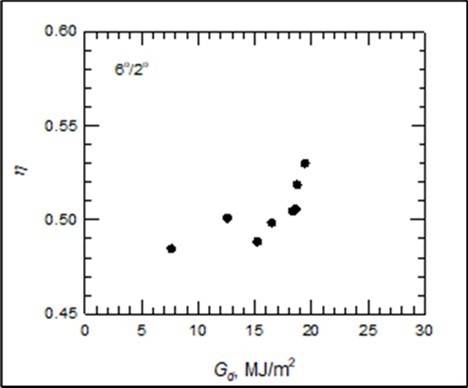
Download figure
Figure 7. Thermal efficiency for a setup of 6°C/2°C; 3°C/1°C 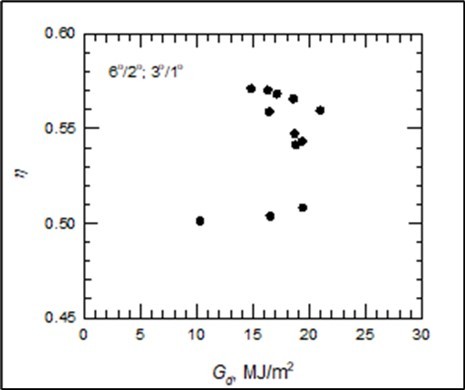
Download figure
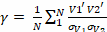
Another two-stage setting of 8°C/2°C and 3°C/1°C is used to control the circulation pump. An increase in the temperature difference (8°C/2°C and 6°C/2°C) produces a decrease in electrical consumption because of the circulation pump. Figure 8 shows the relationship between the solar heat that is collected and the value of Gd. The cross-correlation between the two time series (Gdand solar heat) is determined. The correlation coefficient, g, is defined as Equation 3:
 (3)
(3)
where N is the number of tests, V1’ and V2’ are the fluctuating components for the two time series, and sV1 and sV2 are the values for standard deviation. The value of γ is 0.97. This shows that solar heat is closely correlated with the value of Gd. The average value of η is 0.539, which is slightly less than the value for a two-stage setting of 6°C/2°C; 3°C/1°C. The variation in the value of η with Gd is shown in Figure 9. The data is scattered but there is an increase in the value of η as Gd increases.
Figure 8. Thermal efficiency for a setup of 8°/2° and 3°/1°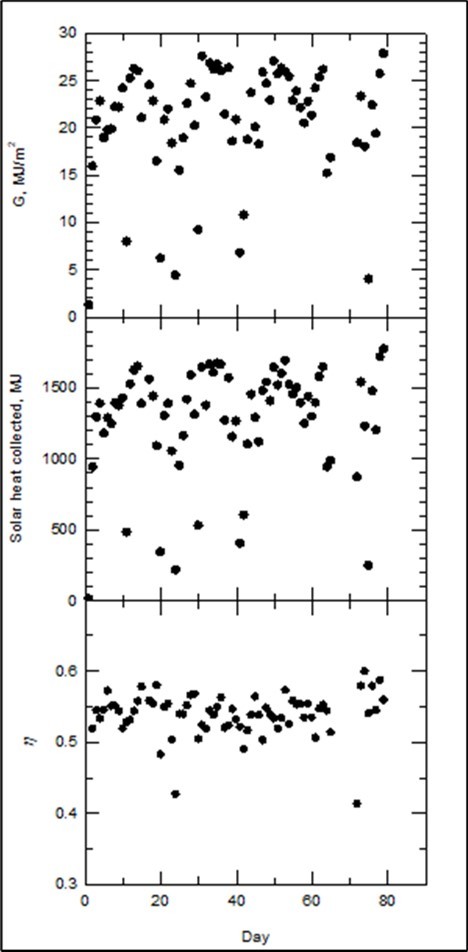
Download figure
Figure 9. Thermal efficiency for a setup of 8°/2° and 3°/1°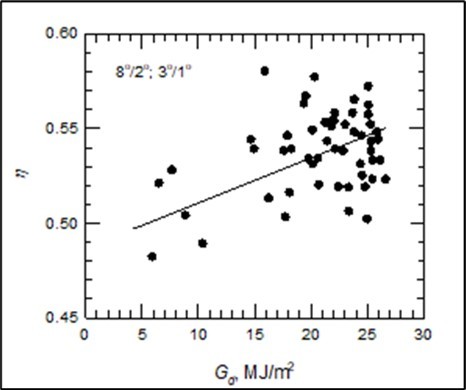
Download figure
Energy savings and carbon reduction
Figure 10 shows the data from the field measurements for the baseline case. The efficiency of the SWH depends on the incident solar radiation, the thermal performance of solar collectors, and the hot water consumption pattern. As a pre-heating system (indirect mode), it produces 3.8%-4.3% of the heat demand (solar fraction) for the feed plant per month (steam at 6 bar and 158°C) which saves energy and reduces carbon emissions.
The capital cost for the SWH (Asc = 118 m2) is approximately 43,000 US$. The plant consumes approximately 70,000 liters of low sulfur light fuel oil per month. A reduction in the price of low-sulfur light fuel oil creates a longer payback period. For low-sulfur light fuel oil at a price of 625 US$/kL and annual consumption of 840 kL, a supply of 4% heat demand produces annual fuel savings of approximately US$21,000, so the simple payback period is 2.05 years. This is much less than the expected service period of 15 years for an SWH 20. This result shows that it is financially viable to use an SWH for the feed plant and an industrial heat process.
Sermab et al. 30 showed that low-sulfur light fuel oil has a carbon emission factor of approximately 3.114 kg/L (or 11.788 kg/gallon). The feed plant consumes approximately 70,000 liters per month so carbon emissions per annum are 2616 tCO2e. Supplying 4% heat demand corresponds to a reduction in carbon emissions of 105 tCO2e. Therefore, the annual carbon emissions for this feed plant are not within the scope of the carbon tax program in Taiwan (≥ 25,000 tCO2e). The results of this study show that the SWH for this feed plant is financially viable, but there is no add-value (carbon tax as additional operating fee). In terms of these results, the low carbon tax scheme and annual carbon emissions criterion for Taiwan cannot be used in isolation as a climate policy instrument. A revised scheme (a lower criterion for levying a carbon fee or higher carbon tax) is required for the net-zero transformation process.
Figure 10. Monthly solar fraction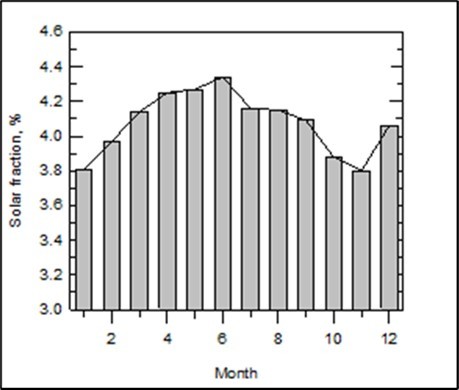
Download figure
Conclusions
Field measurements are conducted for an SWH in a feed plant. The setting for the thermostat has a significant effect on the thermal efficiency of a system and on the real energy savings. For the baseline case, the circulation pump is switched on and off if the temperature difference between the water storage tank and the water outlet for the solar collectors is 6°C and 2°C. The thermal efficiency of the system is 0.488-0.530 and the value depends on the daily incident solar radiation.
For a forced-circulation SWH, a single stage setting for a circulation pump is commonly used. This study uses a two-stage setting (6°C/2°C and 3°C/1°C) to collect more solar energy if the incident solar radiation is less intense and this produces an increase in thermal efficiency (= 0.501-0.571). The thermal efficiency is approximately the same if there is an increase in the setting for temperature difference (8°C/2°C and 6°C/2°C) for a greater value of incident solar radiation. Less electrical power is consumed by the circulation pump. For a lower value of incident solar radiation, a two-stage setting increases the thermal efficiency of the system.
A simple payback analysis for this pre-heating solar thermal system demonstrates that the payback period is approximately 2.05 years and the expected service period is more than 15 years. This verifies the financial viability of the scheme. The “Climate Change Response Act” in Taiwan was amended and enacted in 2023. The carbon tax scheme in 2025 aims to strengthen carbon reduction targets. However, the annual carbon emissions for this feed plant are not within the scope of the carbon tax program and the criteria for levying a carbon fee in Taiwan. Other than an increase in corporate value, the scheme does not motivate investment in solar water heaters in the industrial sector so in this respect it does not promote transformation toward a low-carbon society. A revised carbon tax scheme is required.
References
- 1.Li Y, Wang X, Qin Q. (2025) Comparative analysis of carbon tax and carbon market strategies for facilitating carbon neutrality in China’s coal-fired electricity sector. Sustainability. 17(5), 1961-10.
- 2.Lyu Y, Xiao X, J N &Zhang. (2025) Green finance policy and corporate carbon emissions: advancing corporate sustainability. Humanities. Social Sciences 12(1), 1-15.
- 3.X N Zhang, C B Liu, J X Zhang, J T Liu, Hu W. (2025) Evolution trends in carbon emissions and sustainable development paths in China’s planting industry from the perspective of carbon sources. Sustainability. 17(6), 2772-10.
- 4.Voigt C. (2016) The compliance and implementation mechanism of the Paris Agreement. Review of. European, Comparative & International Environmental Law 25(2), 174-185.
- 5.Horobet A, O C Popovici, Zlatea E, Belascu L, D G et al. (2021) Long-run dynamics of gas emissions, economic growth, and low-carbon energy in the European Union: The fostering effect of FDI and trade. Energies. 14(10), 2858.
- 6.M K Nematchoua, J A Orosa, Ricciardi P, Obonyo E, Sambatra E J R et al. (2021) Transition to zero energy and low carbon emission in residential buildings located in tropical and temperate climates. Energies. 14(14), 4253.
- 7.Li W, Wang J. (2025) finance and carbon neutrality: The role of green bonds. ESG investments, and carbon pricing.Journal of Environmental Management 395, 127731.
- 8.Coimbra C F M. (2022) Best practices in renewable energy resourcing and integration. Journal of Renewable and Sustainable Energy. 14(3), 030402.
- 9.M P Pablo-Romero, Sanchez-Braza A, Romero M G P. (2022) . Renewable energy in Latin America. AIMS Energy 10(4), 695-717.
- 10.Fareed Z, U K Pata. (2022) Renewable, non-renewable energy consumption and income in top ten renewable energy-consuming countries: Advanced Fourier based panel data approaches. Renewable Energy. 194, 805-821.
- 11.Mauthner F, Weiss W, Spörk-Dür M. (2025) Heat Worldwide. AEE-Institute for Sustainable Technologies. , Gleisdorf, Austria
- 12.W A Fadzlin, Abd Rahim Hasanuzzaman, Amin N, N, Said Z. (2022) Global challenges of current building-integrated solar water heating technologies and its prospects: A comprehensive review. Energies. 15(14), 5125.
- 13.G, Xydis G. (2022) Solar thermal in the Nordics. A belated boom for all or not?.AIMS Energy. 10(1), 69-86.
- 14.Bellos E, Papavasileiou L, Kekatou M, Karagiorgas M. (2022) A Comparative energy and economic analysis of different solar thermal domestic hot water systems for the Greek climate zones: A multi-objective evaluation approach. Applied. Sciences 12, 4566.
- 15.A, W E Alnaser. (2001) Experimental study on thermosyphon solar water heater in Bahrain. Renewable Energy, 24:. 389-396.
- 16.M R Islam, Sumathy K, S U Khan. (2013) Solar water heating systems and their market trends. Renewable and Sustainable Energy Reviews. 17, 1-25.
- 17.Mekhilef S, Saidur R, Safari A. (2011) A review on solar energy use in industries. Renewable and Sustainable Energy Reviews. 15(4), 1777-1790.
- 18.Lauterbach C, Schmitt B, Jordan U, Vajen K. (2012) The potential of solar heat for industrial processes in Germany. Renewable and Sustainable Energy Reviews. 16(7), 5121-5130.
- 19.M I Ismail, N A Yunus, Hashim H. (2021) Integration of solar heating systems for low-temperature heat demand in food processing industry - A review. Renewable and Sustainable Energy Reviews. 147, 111192.
- 20.W M Lin, K C Chang, Y M Liu, K M Chung. (2012) Field surveys of non-residential solar water heater in Taiwan. Energies. 5(2), 258-269.
- 21.K C Chang, W M Lin, K M Chung. (2018) Solar water heaters as the preheating system for industrial processes. Energy Efficiency. 11(3), 755-760.
- 23.K M Chung, C, K C Chang. (2018) Effect of diffuse solar irradiation on the solar thermal performance of solar collectors. Case. Studies Thermal Engineering 12, 759-764.
- 25.T E Hsieh. National Cheng Kung University (2022) Mapping the global solar radiation and diffuse fraction distributions in Taiwan using Kriging method. Master thesis. , Tainan, Taiwan
- 26.H P Garg. (1973) Design and performance of a large-size solar water heater. Solar Energy. 14, 303-312.
- 28.Gielen D. (2017) Perspectives for the energy transition - investment needs for a low-carbon energy system (International Energy Agency, International Renewable Energy Agency).